

Largo
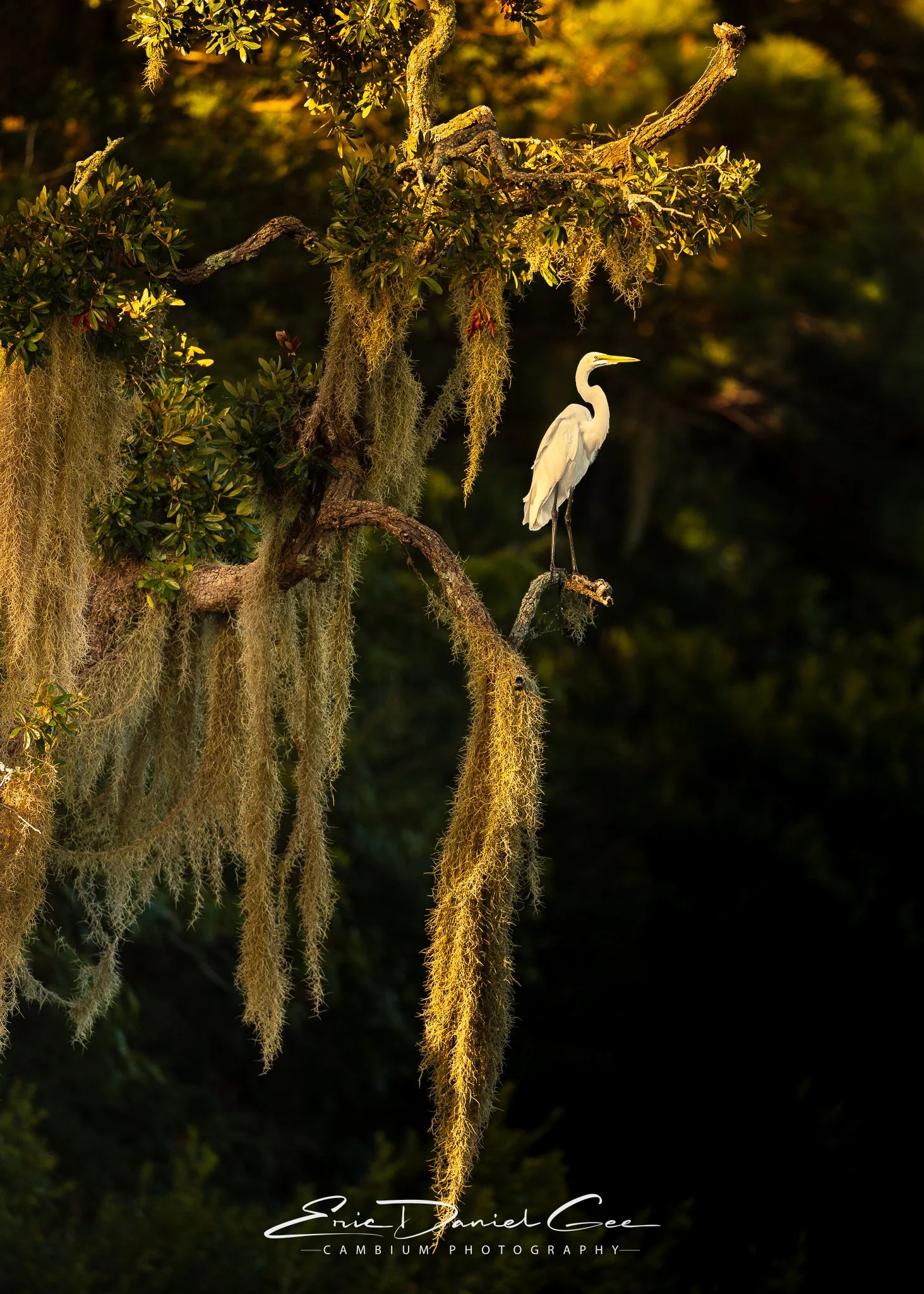
“Never was a shade so gentle and lovely.”
Dawn breaks over Bayou Lacombe, and the water is still enough to hold the kayak steady while the light finds its way in. A Great Egret (Ardea alba) stands motionless in the crook of a live oak, its branches hung heavy with Spanish moss that catches the first gold of morning like votive light. Photographed in late August, the moss falls in long curtains, torn and parted like the temple veil, as if this wilderness sanctuary has opened its own holy of holies. The egret waits in that opening, unhurried, a quiet act of stillness and grace playing out before the swamp fully wakes.
I found this egret alone, high in a canopy draped with moss, and for a long while I did not move. There was no one else out there. No other photographers, no distant voices, no sound but wind moving through old growth. In that stillness I have learned that I am never truly alone.
The tree in this image asks nothing of the egret. It simply provides. Branches for rest. Cover from wind and rain. Shade from a sun that can be just as unforgiving as any storm. The egret did not build this shelter. It did not earn it. It only had to come and receive it. I think that is exactly how God moves through our lives. We rarely notice the shelter until we are standing under it. God provides for us the same way this tree provides for the bird, quietly, constantly, often without our asking and sometimes without our even knowing. He is there in the ordinary hours, and He is there in the darkest ones, holding up something steady over our heads when we cannot hold ourselves up.
It is in moments like this, standing alone under a canopy I did not build and cannot fully explain, that I feel closest to that kind of provision. And it is in those same moments that I feel my dad the most.
If you have not already, click the link above and let the aria play as you sit with this image. It will say more than I can.
Before my father passed away in 2015, after a brief yet vicious battle with bone cancer, he selected this piece of music to open his own funeral. We asked my mother why. She did not know. I cannot remember Dad ever speaking of this particular aria, though he loved opera deeply. His record collection of the classics was immense, shelves of it, a lifetime of listening. Somewhere in all of that, this piece found him, and he chose to leave it as his last word to us.
Tender and beautiful fronds
of my beloved plane tree,
let Fate smile upon you.
May thunder, lightning, and storms
never disturb your dear peace,
nor may you by blowing winds be profaned.
Never was a shade
of any plant
dearer and more lovely,
or more sweet.
The aria itself is secular. Handel wrote it for his opera Xerse, sung by a king praising the shade of a tree, with no scripture or liturgy behind it. And yet Dad, a man of deep faith, chose it to open his funeral. I do not think that was an accident. I think he heard something sacred in it anyway, the same way I do now. Dad spent his life providing for his family, giving them shelter the way this tree gives it to the bird resting in its branches. Somehow he knew that language before I did. I believe now he was pointing past himself, to the greater shelter he had already found.
I share this as a living memory to my parents. It is not an easy thing to put this deep a feeling into words, but this is what I carry with me in the field. A closer connection to God, found through nature, in the quiet places most people never see. God is there. My ancestors are there. Dad's voice, and this mystery, is still there.
I only hope these images can carry some part of that beauty, wonder, and majesty to those who see them, the way it was given to me. And I hope, more than anything, that they bring the same peace and rest I have found, to anyone who stops long enough to look.
